01
نمائشShow, 2001

The border is not between two places. It is between two centuries.
The house — scrollSarhad has worked out of one building in Lahore since 1954, on frames that have not changed. What comes out each season is drawn from what is already in the room — patterns come off the shelf, get altered, and go back.
These are the house's own photographs of it: shows, fittings, a stairwell at one in the morning. None of it was styled and most was never meant to be kept.
01

02

03

04
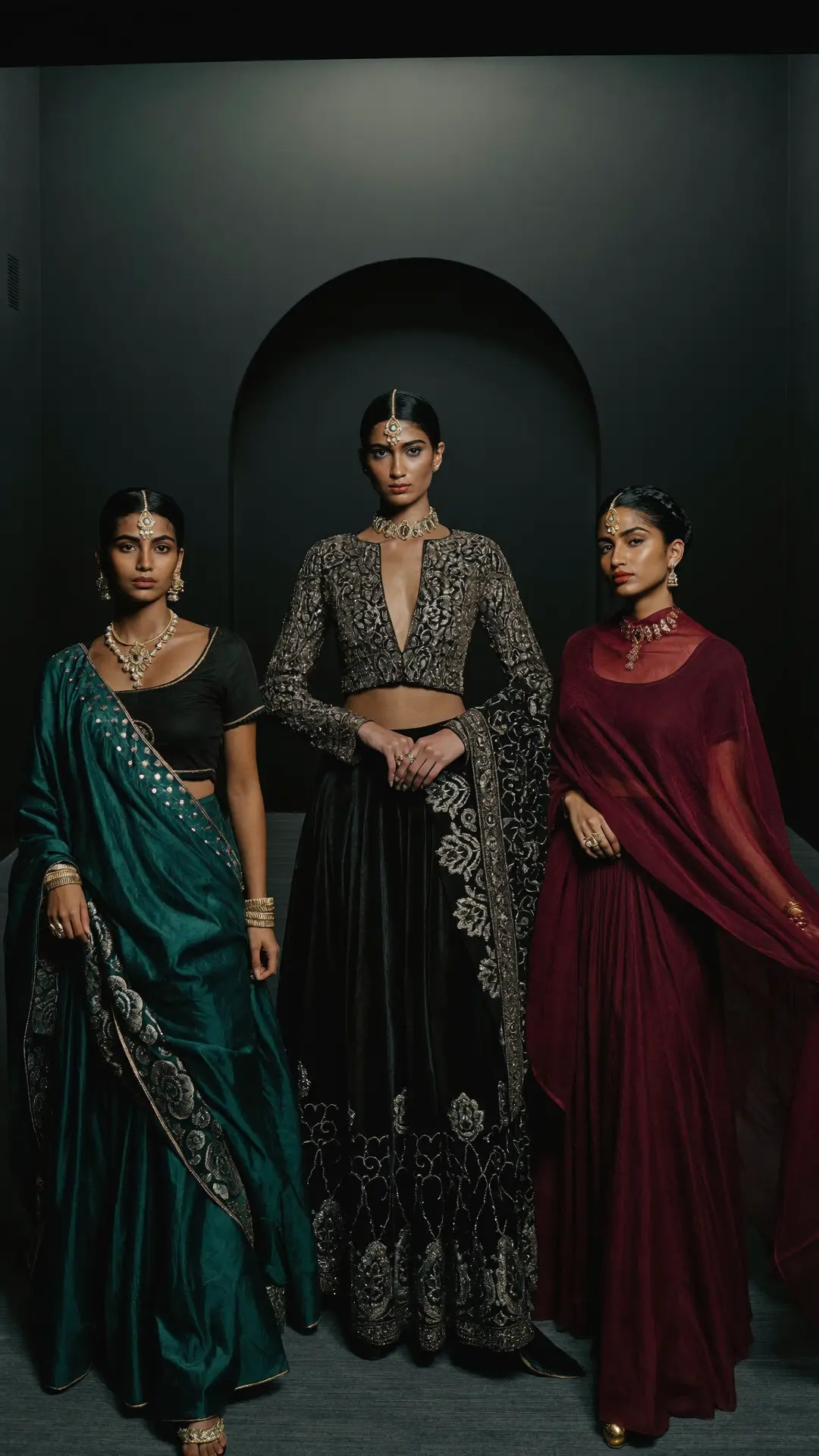
Nine pieces, shot by lamplight over eight months. Gold thread needs a moving flame to do what it does, so nothing here was lit any other way.

I
Ivory, drawn tight at the waist and left to fall. The gold runs one line from collar to hem — a single placket, eleven days on the frame, nothing else anywhere on the piece.

II
The vine climbs the skirt in six panels and stops short of the hem, so the eye finishes the line itself. Two karigars worked opposite sides of one frame for five weeks to keep the halves matched.

III
Velvet takes coiled wire better than any other ground because it holds the stitch without puckering. The border is one continuous scallop — begun at the left seam and closed at the same seam nine days later.

IV
Sage is the hardest ground in the collection to light. Each buti is worked separately and placed by eye rather than to a grid, which is why the scatter reads as falling rather than as printed.

V
Pearl over gold, which is the house's oldest combination and the slowest — every pearl is knotted rather than glued, so the piece survives being sat down in.

VI
Every rose is built up in floss silk and wired from behind so it stands off the cloth. The belt is the only hard element; everything above and below it is deliberately soft.

VII
Silver on indigo is the hardest pairing in the house — the wire disappears if the ground is a shade too light. The cape is sheer so the work reads twice, once through it and once beside it.

VIII
White on rose, worked so densely the ground barely shows. The quietest piece in the collection and the one that takes longest: there is no motif to hide behind, so every stitch is on show.

IX
The last nine inches of a dupatta. Every leaf is stitched through both faces of the georgette, which is why the hem holds its scallop instead of collapsing the moment it moves.
Two hands, a hooked ari needle, and gold laid onto velvet stretched taut on an adda. Everything else on this page is a consequence of this photograph.

340hrs
The longest single panel in the collection
9hands
Karigars on one frame at a time
0prints
Nothing in the collection is printed
Nothing is stocked and nothing is sized. Each piece is cut to the wearer and worked to order, and the embroidery alone runs eight to fourteen weeks — longer for a bridal panel. Read this before you write; it is most of the commission.
Studio note · Bin Zubair
You have just read the third version of this. The first two were built, looked at, and thrown away — which is the part of a brand build nobody publishes and the only part that teaches anything.
The first argued “western cut, eastern surface” — a fusion house. It was coherent, and it described clothes that were not in the photographs. A positioning the work contradicts is not a positioning, it is a wish, and the pictures win that argument every time.
The second argued heritage, which was true, and was still wrong: a list of chapters rather than a sequence. History, then craft, then collection, then contact. Every section defensible, the page as a whole telling a reader nothing to do. You would learn the house was old and skilled, and leave.
This version is structural rather than descriptive: the site is one commission, from the archive the pattern came out of to the fitting room. Six stages, in the order they actually happen — which is also the only reason they are numbered. You cannot be fitted before the cloth is chosen, or choose cloth before seeing where it came from.
The last stage is the enquiry, reached having been walked through exactly what is being commissioned. Conversion stops being a thing bolted onto the end.
This identity sat on bone for two versions — the safe ground for a heritage couture house. But every SARHAD photograph is shot into the dark: candlelight, black studio, oxblood panelling. On a pale ground each one became a lit box with a picture inside it. On #1A0F12, the colour of unlit velvet stretched on an adda, the same photographs stopped being framed objects and started being lit ones.
On bone, the gold measured 2.49:1 against its background — far below the 4.5:1 body text needs — so it needed a second, darkened gold just for numerals. Two golds, because the first could not be read. On the dark ground the same family clears 7.74:1 at full strength, and the second gold was deleted. One gold now, used as thread and as type, never as a fill — which is how the material behaves on the cloth.
The display face was Fraunces, and it went for a reason that has nothing to do with quality. Against a cream ground with a tracked monospace docket, the page landed inside two of the looks design defaults to right now. If the face is guessable from the category, it is not a decision. Gambetta replaced it on an argument about instruments: its stress comes off a broad-nib reed pen, which is what Nastaliq is written with. The Latin and the Urdu share an origin rather than being set side by side and hoped over.
A Lahore house captioning itself in Latin first is apologising for where it is from.
Every craft and every specification is named in Nastaliq first, with the Latin small underneath. It is the cheapest decision on the page and the one that does the most: nothing about the layout changes, only the order of two lines.
Three theses, two abandoned after the page had been built. The failures were not waste — the fusion direction is what proved the photographs had to lead, and the heritage direction is what proved the page needed an order rather than a set of chapters. Neither could have been reasoned out in advance. They had to be built and looked at.
That is most of what a brand build is: deciding the same question several times until the answer stops changing. It is also why we do not hand over a folder of assets. The assets are the residue; the decisions are the thing, and they only hold if someone can say why each one was made.